Tuesday, 24 February 2015

Home education and chronic illness

Is this for you?


First up, let me tell you who this post is not aimed at. Please know this was not written for you if you suffer from chronic illness, you are satisfied with your schooling choices, and you clicked on this in a state of incipient outrage, thinking "Oh, great. Lady, I am barely functioning and now I'm supposed to feel guilty for not homeschooling my children?!"

You are walking a hard road, I know. Please trust my sincerity when I say that my intention is to encourage and not to discourage.

I am writing this post in response to persistent questions from the following two groups of people:

  • People like my friend with CFIDS who loves the idea of home education for possible future children, but is fearful of her ability to do so due to health issues.
  • Parents who desire desperately to bring their children home to educate them but are fearful of their ability to do so due to health issues.

If this is you, welcome. Now, what can I possibly say that would encourage you? I'd like to make three statements for you to ponder.

  1. You can home-educate your children. 
  2. You may not be able to home-educate the way you imagined. 
  3. Your children will learn from your illness, not in spite of it.
Let me explain myself.

1. You can home-educate your children.

How can I say this? On a personal level, because I was home-educated by someone with a chronic illness, and I've known others who've done so, with wonderful fruit in their own and their children's lives. Read this testimony by Kimberley, a home-educator whose own mother home-schooled through cancer (there's more here).

Now. Here's the important qualifier:


2. You may not be able to home-educate them the way you imagined.*


(*It's worth noting that this seems to be true of every home-schooler I have ever known.)

It's common for people in your situation to believe that they are disqualified from home-educating because of one of the following:

  • You don't have the energy to take your children on field trips.
  • You don't have the time and focus to implement the perfect curriculum.
  • You've forgotten all your high school maths (and maybe also what day it is).
  • Sometimes you have to stay in bed all day.
Because of my mother's illness, she simply wasn't able to spend time drilling me in maths memorisation or doing awesome chemistry experiments, both of which are by nature things she would have enjoyed. Do I feel like I was short-changed by my education due to missing out in these areas? Not a bit of it. If you have doubts, you can read my traditionally-schooled, academically-focused husband's perspective on my education.

By now you are either all upset at me and/or you're wondering how on earth my parents managed to give me what my husband and I (and others) consider to be a first-rate education. 


Two strategies for home-educating with a chronic illness

I'm going to share two key strategies my mother used as she home-educated me through her 15 years of illness, which started when I was about 3.

1. Have simple but significant goals for your children's education.

My mother focused her efforts on teaching me a small number of vital skills. Briefly, they could be summed up as:
  1. Character attributes. The ones my parents insisted on were obedience, respect, cheerfulness, and diligence.
  2. Self motivation. I was never allowed to say "I'm bored". Tasks would be assigned to me if I did, and I usually preferred to come up with my own ways to occupy my time, which suited my mum just fine!
  3. Discernment. This was crucial, otherwise I could have simply become excellent at frittering away my time. I was taught to evaluate my interests and materials for quality, suitability and usefulness, from a worldview shaped by the Bible.
  4. Aspiration. To make big plans/ideas and to pursue them using the above skills.

Investing in these attributes/skills meant that she could be reasonably confident in my use of time and pursuit of my interests, with minimal (but wise) supervision from her.

2. Delegate.

Yes, that's right. This may seem counter-intuitive, but you don't have to do everything yourself. While my education was very much home-based and parent-directed, I received outside tuition in skills my parents didn't possess and which are hard to learn in any other way than in a hands-on context. In my case, it was music (harp, piano, singing), dance, French, and horse-riding/horse care. When I was 14 I experimented with enrolling in Adult Ed classes and used the information and skills I learned there to springboard into further self-directed learning.

If you are too ill to get out much, you absolutely need to avoid becoming a full-time chauffeur to your child/ren. There are good private tutors who will come to your house. There may be trusted relatives or other families who will give your child a lift to a lesson.

Consider this: delegating to family members, especially older relatives, can be richly rewarding for your family. Do you have an elderly relative who knows how to crochet, tat, knit, sew, kickbox? Is there an uncle with an interest in military history? God designed human beings to thrive as they pass on and receive knowledge in a mentoring/discipling relationship. Gardening, cooking, painting, preserving, wood-working, building...these skills are often lost between generations for no other reason than that it just didn't occur to anyone to initiate that kind of mentoring relationship.

I know, I know -- you may have a rotten relationship with your extended family. That may be one reason that home-educating appeals to you - you long to build a better, closer kind of family. It may go against the grain, but respectfully asking a family member to share their specialist knowledge/skills with your child is almost certainly going to be a step in the right direction. The worst they can say is no, right?

A really low-stress and achievable method of delegation is audio books. When I was a child, I listened to many classic books this way. When I learned to read, I went straight to Jane Austen's Northanger Abbey to find my favourite bits for myself which I already knew from the recording. Borrow them, buy them, subscribe to Audible. If you don't know what books to choose, find a good list (like this one or this one from my friend Suzannah).

Ok, here's my third and final thought.

3. Your children will learn from your chronic illness, not in spite of it. 

As Kimberley says,
"Through cancer God taught our family that our focus should be relational, first relationship with God, then with others. We are called to love and care for people, we should work to improve the lives of people, we must appreciate and enjoy people. It seems simple when you read it, but it’s uncommon in this world. It’s much more common to sacrifice people and relationship for a bigger home, a nicer car, a better education and even recognition, or a certificate of completion."
As they are at home with you, your children will learn from watching how you deal with your illness. If you use what energy you have to focus on the big things rather than feeling guilty about what your kids aren't doing, your children will learn from that. If you are a Christian and you are trusting God through the grief, pain and disappointment of ill health, your children will learn from that.

Your children don't need to be shielded from your illness. Just like Kimberley and her family were blessed through her mother's fight with cancer, they can learn lessons through your illness that will teach them wisdom, compassion and courage. I learned that my mother's deep desire to have a close relationship with her only child and to give her a lifelong love of learning could not be thwarted by 15 years of serious and often misdiagnosed ill health. I know that if I face serious health issues in the future, my attitude will be shaped by having seen God's grace to my mother and our family in action.

Friends, if you long to do this, if your deep desire is to bring your children home for their education, and you are bursting with questions, see the links below to women who blog about their experiences in this area, with lots more practical advice than I've given here. I'd also be very happy to put you in contact with people like my mother who can share their stories.


My mother and I climb Marion's Lookout
(in Tasmania's Cradle Mountain National Park)
 in her post-Chronic Fatigue era.


Links:
6 Tips for Homeschooling with a Chronic Illness
Homeschooling when Mama has a Chronic Illness
Homeschooling with Chronic Illness
10 Tips to Help You Succeed 


Sunday, 1 September 2013

Politics and Providence on the Prairie

Laura Ingalls Wilder in Missouri

I'm a late convert to Little House. (Am I really a homeschooler if I didn't read/quote/re-enact the books countless times growing up?) My husband and I read the series to our oldest daughter last year. All three of us discovered it at the same time. 

There were a lot of tears. Most of them were not Eve's. 

The surprise for us was the high (dare I say literary?) quality of the writing. Now, I don't mean that in some high-falutin' way. Our 3-year-old was just as drawn in. But this is the mark of a real classic, in my opinion. We read it on many levels, all of them satisfying (I'd rate The Lord of the Rings, Shakespeare's plays, and the novels of Jane Austen and John Buchan highly in this regard). 

 It turns out our introduction to Little House has come just as the books are showing up in the news again, in a few different ways. For starters, Laura Ingalls Wilder's first draft of the series, her memoir entitled Pioneer Girl, is being made available to the public for the first time. Also, the whole Little House series has just been repackaged into one volume sans illustrations (more's the pity!) to appeal to 'serious' adult readers. 

And finally, this article in the Boston Globe showed up. The writer's big idea is that when Rose Wilder Lane assisted her mother in fictionalising her memoir into children's stories, she did so through a deliberately Libertarian grid, transforming her family's harrowing frontier experiences into shiny, corn-fed propaganda, as a well-aimed blow at the social-welfare progressivism of FDR's "New Deal." 

 Now, I have no problem with saying that Rose was a Libertarian. She was. And Edith Nesbit helped found the Fabian Socialist movement, and Frances Hodgson Burnett used her children's novels to promote Eastern Mysticism. Children's authors do not inhabit some anodyne land of Nursery neutrality. They see the world through one lens or another, just as we do. 

Here's what I take exception to: 
1. Politicising a beloved series of books which has united people from all over the map, literally and figuratively. 
2. Accusing the books of whitewashing the frontier experience. 

 I'm not going to go point by point through the article, but as an example -- 

Lane must have known, as she redrafted her mother’s handwritten memoirs, that this notion of pioneer bravery—and the very real fortitude of the family—would prove an irresistible American theme. The result was a series of books that helped instill a deep national code of frontier values, including the notion that isolated Americans can thrive because the government leaves them to draw only on their personal energies and ethics. It’s an appealing idea, and it has become woven into our image of the pioneers. But it’s not the full story of what happened out there on the prairie. 

She also speculates that Rose made up a canny appeal that Pa Ingall's uses to quell a riot in The Long Winter, calling it "free-market speechifying". She completely misses his point, which was to persuade a foolhardy store-owner to feed the starving community on credit -- not to instruct everyone in the benefits of capitalism. (Indeed, I think most people would agree that the Little House books are remarkable for their lack of overt didacticism.)

The Little House books barely mention the obvious, which is that the impoverished Ingallses never could have gone to Dakota Territory without a government grant: Like most pioneers, their livelihoods relied on the federal Homestead Act, which gave settlers 160 acres for the cost of a $14 filing fee—one of the largest acts of federal largesse in US history. 

Did she read the same books I did? Does anyone want to go count the number of times the land-grant set-up is clearly explained in these stories? 

Woodside contrasts the Little house books, in which Rose supposedly "recast the stoic, sometimes confused pioneers as optimistic, capable people who achieved success without any government help" with Laura's unvarnished original manuscript: 

Wilder’s memoirs offer a picture of the costs and risks of isolation that never made it into the book series: A baby brother who died at 9 months. A miserable year working and living in an Iowa tavern. A pair of innkeepers who murdered guests and buried them out back. Another pioneer couple who boarded with them during the Long Winter whose attitudes were far more whining than stoic. 

What about the horrifically unhappy family Laura boards with as a young schoolteacher? You know, the wife that goes half-crazy with the cold and isolation and waves a knife around at her husband in the night 'cause he won't take her back East? What about the lynching? The child bride? The massacre? The two guys who died in the blizzard because it didn't occur to them to huddle together? The monster locust attack? Pa's inability to make farming any kind of success? 

Surely it is just as possible that Laura and Rose had personal or literary reasons for their selection of certain anecdotes and story-lines over others, rather than primarily political ones. I can't help but suspect that it is Woodside herself who has a political axe to grind. 

Finally and most significantly, Woodside reduces everything to a binary grid: self-reliant versus government-reliant. But there is another option. 

The Ingalls family doesn't have to choose between relying on the government or themselves because, at back of it all, they acknowledge the sovereignty of someone greater. 

In one of the most poignant moments in the series, the Ingalls family bow their heads over their Christmas meal, which is 6 months late due to a freak season of blizzards which has kept an entire community in a desperate and harrowing condition of freezing and starvation for almost half a year (The Long Winter). 

What words does Pa choose to grace this meal? "We thank Thee for Thy bounty."

Wednesday, 28 November 2012

Just my cup of Tey

You reach the ripe old age of 31 and you think you've already discovered all those good, obscure, out-of-print (or-almost-out-of-print) authors. And if you haven't read all of them yet, you at least know their names.

Then you find out you were wrong.

My first inkling of Scottish author Josephine Tey came from my friend Suzannah. I quickly got The Daughter of Time (1951) out of the library, and I was hooked.

Elizabeth Mackintosh - aka Josephine Tey and Gordon Daviot

I don't know how I missed her before. No less a personage than Peter Hitchens (that would be the more-famous Christopher's redeemed brother) has praised her books, most particularly The Daughter of Time (which the Crime Writers' Association voted as the best crime novel of all time in 1990):
Josephine Tey’s clarity of mind, and her loathing of fakes and of propaganda, are like pure, cold spring water in a weary land. Her story-telling ability is apparently effortless (and therefore you may be sure it was the fruit of great hard work. (As Ernest Hemingway said ‘if it reads easy, that is because it was writ hard’) . But what she loves above all is to show that things are very often not what they seem to be, that we are too easily fooled, that ready acceptance of conventional wisdom is not just dangerous, but a result of laziness, incuriosity and of a resistance to reason.
To these qualities I would add her attentiveness to the twin themes of justice and mercy - two concepts that both crime writers and Christians must come to terms with. In the life of any literary sleuth worth his salt (and Inspector Alan Grant, her balanced and urbane detective, certainly is), there come times when he has to make tough calls about innocence and guilt. A detective novel can make an easy pulpit from which to preach relativism. Tey doesn't. The only novel I've read of hers that ends badly (won't tell which one) does so to prove the point that when we humanistically take ethical situations into our own hands, we make a right old mess of things.

Providence is often pivotal in Tey's novels. In The Franchise Affair (1951), the faithful prayer of the protagonist's aunt seems to turn the course of the novel. And, though I found it to be the least satisfactory of her novels which I have read so far, the premise of Miss Pym Disposes (1946) is explicitly based on the axiom "Man proposes, but God disposes". 

I know nothing of Tey's personal theology. Coming from Scotland (her real name was Elizabeth Mackintosh) and given the above themes, I think a case could be made for a strong Presbyterian/Calvinist cultural influence.

Treatment of romantic love can be a deal-breaker for me. I really enjoy the mysteries, locations and plucky heroines of Mary Stewart's novels, but the dangerous-love-interest trope leaves me yawning. Tey's romances are more solidly built, and with a lighter touch. They feel like they could actually result in a happy marriage. (A neat bit of trivia: Mary Stewart paid homage to Tey's Brat Farrar (1949) in her mystery-romance The Ivy Tree.)

However, Tey isn't completely kosher (is there a Presbyterian equivalent?). Her interest in the pseudo-science of physiognomy/anthropological criminology - an offshoot of social Darwinism - is tiresome. For instance, did you know people with slate-blue eyes are 'oversexed'? But since even the very best of authors (yes, John Buchan, I'm looking at you!) was not immune to this cultural claptrap, I can forgive her.

What will you find in a Josephine Tey novel? An intriguing premise, likeable characters, fast-paced plotting and all of the delightful jolly-hockeysticks dialogue one expects from British 1920s-40s pop novels.

If Mary Stewart novels are your guilty pleasure, I recommend Josephine Tey's novels: all the pleasure and none of the guilt.

Here are some e-texts at the University of Adelaide.


Saturday, 22 September 2012

A project or two

Our lovely newborn daughter, Lilia, thoughtfully deferred her birth until halfway between the birthdays of her Mama and Papa. This gave us time to finish two projects that I'd been dreaming of.

Unfortunately, I am not a sewing/crafting/knitting woman. I don't rule out being one at some point in the future, but I am not one now. This is why I am inordinately stoked that we got to make something ourselves for our girls and why I feel the need to tell you about it.

The Mobile

Our former next-door neighbour gave us their mobile when Eve was born, but it was a shaky, noisy, flashy mobile (yep, Eve loved it), and ever since it squealed its last I've been dreaming of something a bit more...Etsy.

After a burst of "pinning", I came up with an idea that would utilise my husband's origami skills. He consented and selected this lovely three-dimensional star pattern.

Lilia's mobile

I am beyond happy with this project, especially since it cost us absolutely nothing in cash (I had an old embroidery hoop on hand from my single days and my husband has copious amounts of origami paper from his). I got to sit around in my overly-ripe state and read Anthony Trollope's "The Warden" aloud while Peirce cyphered origami instructions in Slovakian. What could be cozier?

The Paper Dolls


My almost-2-year-old, Meg, has been feeling rather left out that her older sister can play with paper dolls and she can't. I had long suspected that magnetic paper dolls might be the answer, but I couldn't really find the $40 to buy them locally.

Crafty blogosphere to the rescue! Sarah Jane Studios has a winsome set of paper dolls for $3 which she suggests you print out on magnetic paper. (Of course, there are plenty of free paper doll patterns online - Betsy McCall has some gorgeous vintage ones here - but since I was saving so much money by making the dolls myself, I was happy to send a few dollars to Sarah, who runs a home business designing beautiful fabrics.)

Sarah Jane Studios' magnetic paper dolls - well-lit photo from her site on left, chaotic photo from my home on right. (These got stuck together somehow while I was uploading them. Since my techie husband is out right now, that's how they are staying.)
My wonderful mum made lovely drawstring bags out of some fun floral fabric we had lying around, and I bought two small cookie sheets/trays ($3.28) from Big W to use as a backdrop and container for the dolls.

Meg has been very proud and excited to have her own paper dolls, and we made a set for Eve as well. I gave them to the girls the day Lilia was born.

Cautionary note: the biggest expense was - you guessed it - the magnetic paper, which I purchased at OfficeWorks. $20 for a packet of five sheets. This becomes depressing when you look online and see that the same product would have cost you about $8 from Michaels in the US. However, I'm still very happy that I was able to make two sets of magnetic paper dolls for my girls for under $30 total.

And it was fun.

I promise I'll get back to posts about books soon. On the non-fiction front, I'm enjoying Dinah Roe's biography of an important Victorian family, "Rossettis in Wonderland", and slowly but surely working my way through Augustine's "The City of God" (and I mean slowly - don't look for a post on that one before next year!).


Tuesday, 14 August 2012

Reading Jane Austen with my husband


 “When Darcy, in finally confessing his faults, says ‘I have been a selfish being all my life, in practice though not in theory,’ he gets nearer to a complete confession of the intelligent male than ever was even hinted by the Byronic lapses of the Brontes’ heroes or the elaborate exculpations of George Eliot’s.”  - G.K. Chesterton

My husband just finished reading all of Jane Austen's novels. I'm impressed that he had the discernment to see past the uber-feminine stereotypes of Jane Austen's work that are common in our culture and really enjoy the novels for what they are: well-crafted works of art that are popular because they are insightful, funny, balanced and human.

He's in good company. Along with C.S. Lewis, Rudyard Kipling, Henry James, Anthony Trollope, Sir Walter Scott, G.K. Chesterton, and many others, he is now A Man Who Likes Jane Austen. (Theologian Peter Leithart has attempted to lead Uni students in chants of "Real Men Read Austen" - a quick google search reveals mugs and t-shirts with this mantra, just in case you're interested.)

Let me back track. At the time when I met my husband, his immediate off-the-cuff comment about Austen was something like this: "Oh, yes - women sitting around in nightgowns."

I thought he was referring to all those candlelit scenes in the films where the characters brush their hair and speculate about what so-and-so is really thinking (which happens much less frequently in the novels). It took me about a year to realise he thought all Regency dresses looked like nightgowns. They kind of do.

However, while we were engaged, he started with Emma. I don't remember him having an epiphany about it, but after our marriage we settled into a rather nice habit of me reading to him while he does after-dinner cleanup (his idea, I promise!), and somehow, we selected Mansfield Park. 

"What should we read next?" I asked, when we finished it. 

His reply? "Let's just read another Austen because we haven't enjoyed anything else as much."

Peirce's ranking (though he says "they're all great"):

  1. Mansfield Park
  2. Emma
  3. Sense & Sensibility
  4. Persuasion and Northanger Abbey
  5. Pride & Prejudice


Reading through the whole Austen body-of-work (excepting Emma) over a year or so was such a delight - though sometimes I felt a bit like a glutton. Seeing her world through the eyes of my husband was great fun and really surprising. For instance:

  • He didn't understand why Darcy fell in love with Elizabeth and to this day maintains its unlikelihood. (What! Did I give Lizzie a silly voice in my read-aloud?!)
  • He absolutely refuses to see why people don't like Fanny Price and Edmund Bertram.
  • He thought Edward Ferrars should just get a job (he's right).
  • He nearly went batty listening to Willoughby's big explanation scene and wanted to excise it from the novel.

One of the delights of great literature is the way it grows with you - how you can enjoy different aspects of it at different stages in your life. I used to think that Austen's novels were all about courtship, each one ending with a wedding, but now I realise how much they are about marriages, and how surprisingly little weddings themselves actually feature at all.

But getting back to the subject of this post... Just in case you didn't buy my opening paragraph, I thought I'd leave you with a few quotes from some of Jane Austen's more famous male admirers (and some of my other favourite authors): Trollope, Chesterton, and Lewis.

"The faults of some [of Austen's characters] are the anvils on which the virtues of others are hammered till they are bright as steel." - Anthony Trollope

"The Novel of the nineteenth century was female; as fully as the novel of the eighteenth century was male. ... The strength and subtlety of woman had certainly sunk deep into English letters when George Eliot began to write. Her originals and even her contemporaries had shown the feminine power in fiction as well or better than she. Charlotte Bronte, understood along her own instincts, was as great; Jane Austen was greater. The latter comes into our present consideration only as that most exasperating thing, an ideal unachieved. It is like leaving an unconquered fortress in the rear. No woman later has captured the complete common sense of Jane Austen. She could keep her head, while all the after women went looking for their brains. She could describe a man coolly; which neither George Eliot nor Charlotte Bronte could do. She knew what she knew, like a sound dogmatist: she did not know what she did not know--like a sound agnostic. But she belongs to a vanished world before the great progressive age of which I write. ..."Jane Austen was born before those bonds which (we are told) protected women from truth, were burst by the Brontes or elaborately untied by George Eliot. Yet the fact remains that Jane Austen knew more about men than either of them. - G.K. Chesterton
"It is perhaps worth emphasizing what may be called the hardness - at least the firmness - of Jane Austen's thought exhibited in all these undeceptions. The great abstract nouns of the classical English Moralists are unblushingly and uncompromisingly used; good sense, courage, contentment, fortitude, 'some duty neglected, some failing indulged', impropriety, indelicacy, generous candor, blamable trust, just humiliation, vanity, folly, ignorance, reason. These are the concepts by which Jane Austen grasps the world. ... All is hard, clear, definable; by some modern standards, even naively so. The hardness is, of course, for oneself, not for one's neighbors. ... Contrasted with the world of modern fiction, Jane Austen's is at once less soft and less cruel. ... It remains to defend what I have been saying against a possible charge. Have I been treating the novels as though I had forgotten that they are, after all, comedies? I trust not. The hard core of morality and even of religion seems to me to be just what makes good comedy possible. 'Principles' or 'seriousness' are essential to Jane Austen's art. Where there is no norm, nothing can be ridiculous, except for a brief moment of unbalanced provincialism in which we may laugh at the merely unfamiliar. Unless there is something about which the author is never ironical, there can be no true irony in the work. 'Total irony' - irony about everything - frustrates itself and becomes insipid. ... If charity is the poetry of conduct and honor the rhetoric of conduct, then Jane Austen's 'principles' might be described as the grammar of conduct." - C.S. Lewis


Tuesday, 24 July 2012

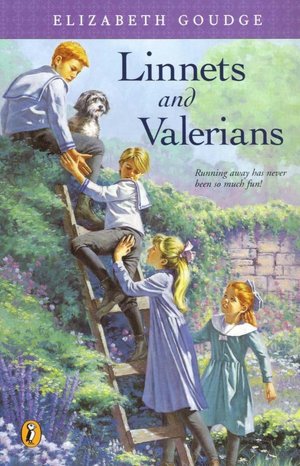
Book Review — Linnets and Valerians by Elizabeth Goudge

"Robert gave the box-room door a resounding kick, merely for his own satisfaction, for he knew that only the kick of a giant would have made any impression on its strong oak panels, and sat down cross-legged on the floor to consider the situation. Betsy was roaring in the bathroom, Timothy was yelling in the broom cupboard, Nan was sobbing in the linen room, and Absalom was barking his head off in the small cupboard where the boots were kept."
This is how Elizabeth Goudge introduces the four pseudo-orphaned Linnet children (and their dog) in the opening of her 1964 novel, Linnets and Valerians.

I thought this was going to be one of my favourite Elizabeth Goudge novels, and certainly my favourite of her children’s books.

But it was not to be.

The wonderful, Goudgian characters and settings, given in richly allusive language, are all present and correct -- but my favourite feature of her writing is missing: a Christian worldview. I’m not meaning to cast doubt on Goudge’s Christianity, but in a few of her books I feel like her worldview just goes AWOL, and this is one of them.

Consider the novel’s treatment of the following themes:
  • Paganism: Protection against evil for the children comes in the shape of such guardians as bees and rue, relics of English paganism. Anybody who knows Goudge’s stories also knows she was perfectly capable of writing of God’s sovereignty and compassion with great poignancy and power. In this book, she just decided to swap out the Living God for a herb.
  • Redemption: For the evil-doers (and I’m talking some mean customers), redemption comes because they suddenly sense they’re beaten and decide to skip town and/or be good from then on. Who knew it was this easy?
  • Forgiveness: Again, it’s something that just happens in this book, on the spur of the moment and without any real effort because everyone’s so happy they can’t remember that they’ve been put through absolute heck for years. This is called forgetfulness. Forgiveness is hard.
  • Witchcraft: The turning point in the book for me was when the good guys decide to actively use “white magic” (herbalism, charms, rituals, etc) to combat the villain’s very black magic. Make no mistake, this is not an allegorical/representational “magic” to signify the supernatural (as in Lewis’ Narnia). God and the Church also exist in the book, but in a pallid, this-is-what-we-do-on-Sunday-before-we-eat-roast-beef sort of way.
Don’t get me wrong. There is a lot to enjoy in this book. The scenes of Uncle Ambrose home-schooling the children (along a classical model) are some of my favourite Goudge scenes ever. The Edwardian Devonshire village and parsonage are among the most unabashedly delightful settings I’ve encountered in literature (and the descriptions of food...oh, my. Pass the yorkshire pud, please!). These details would make the book an ideal 'comfort read'.

But because of the serious worldview problems...let’s just say this won’t be on my children’s reading list any time soon. There’s much better stuff for them to cut their teeth on - stories that will tell them the truth about the big things: 
  • Forgiving those who have wronged you is hard work. 
  • “Let us do evil that good may come” is never a good idea. 
  • Real protection and redemption are gifts of our Saving and Sovereign God.
All lessons that Goudge knew - and wrote about elsewhere - very, very well.


For these and other truths, read: 
  • George Macdonald’s stories, especially The Lost Princess: A Double Story
  • The Chronicles of Narnia by C.S. Lewis

To turn your children into Anglophiles, read these books* by Rosemary Sutcliff:
  • The Armourer’s House
  • The Queen Elizabeth Story

Finally, some Goudge books that will turn you into a fan:

Another view on Linnets and Valerians.

*These contain elements of 16th century English paganism - herbalism, “the Good Folk” - but they are in the spirit of “let’s have fun leaving a dish of milk out for the fairies”, rather than "let's entrust our lives to their protection"!


Tuesday, 10 July 2012

Waiting for Papa — book review of "Lizzie Nonsense"


While my husband is adventuring in Papua New Guinea, it seems apropos to talk about one of my absolutely most favourite picture books - Lizzie Nonsense by Jan Ormerod.

This is a lovely gem of a picture book about a family who live in the Bush in Federation-era Australia, told from the perspective of the oldest of the two children, Lizzie. It focuses on what life is like for Mama, Lizzie and Baby as they wait for Papa to return from selling sandalwood in town (50 miles along sand tracks).

My own recent experience of waiting for Papa to come home has been rather eye-opening. Eight days is a considerable time when the longest period you've been separated from each other previously is three nights. (Yes, I'm aware of how ridiculously blessed that makes me. My cousin whose husband is in the Navy was telling me on Skype that she'll be facing separations of up to 6 months.)

Lizzie's experiences in the book may not include the following:

  • Being upset that Papa was not reachable on mobile phone for most of the trip.
  • Finding out just how far sprinkles go disperse throughout the house after a nutritious afternoon snack of fairy bread (Americans can google that one).
  • Confronting a sudden lack of motivation to do laundry.
  • Discovering EXACTLY how much tidying up Papa does every day without mentioning it.

And now back to the book....

This is one of the few children's books I've discovered at the library which I felt I actually wanted to own. So many picture books are badly drawn, or stylish but "thin". Sometimes the illustrations are very attractive, but don't interact with the text in a meaningful way.

In contrast, Ormerod's watercolour illustrations are just lovely (but not "pretty") and her simple text rewards repeat reading. Lizzie is inventive, fanciful, and capable. Mama is brave and sweet, and there's an undertone of poignance for the adult reader who senses how much she may have given up to live this life. I also love the obvious conjugal felicity of the husband and wife, which balances the awareness of hardships.

While brief, it conveys a wonderful sense of place and family. It's not surprising that Ormerod seems to have based it on the life of her own grandmother.

My daughter Eve absolutely loved this book as a 2-year-old and chose to dress up as Lizzie for my 30th birthday party, though I imagine the book is probably aimed at children around age 4-6.